Yes. A bad camshaft position sensor can cause a no-start condition, although whether the engine completely refuses to start depends on the vehicle’s engine-management strategy and the type of sensor or circuit failure.
For drivers in the United States, a car that cranks normally but refuses to start can quickly become more than an inconvenience, whether it happens in a driveway, a workplace parking lot, or during a road trip. On modern gasoline and diesel vehicles, the engine computer depends on several position signals to determine when fuel injection and ignition events should occur. One of those inputs is the camshaft position sensor. When its signal disappears, becomes erratic, or no longer agrees with the crankshaft position signal, some vehicles may experience extended cranking, intermittent starting, stalling, or a complete crank-no-start condition.
However, a no-start plus a camshaft-related trouble code does not automatically prove that the sensor itself is bad. Damaged wiring, a corroded connector, poor electrical power or ground, a faulty crankshaft position sensor, mechanical timing problems, a damaged trigger wheel, or even low battery voltage can produce similar symptoms. The most useful approach is therefore to confirm what the engine is missing during cranking before replacing parts. This guide explains why a camshaft sensor can prevent an engine from starting, the symptoms that strengthen the diagnosis, and a practical troubleshooting sequence that helps U.S. vehicle owners avoid unnecessary repairs.
Source: autoquarterly.com
Can a Bad Camshaft Sensor Cause No Start?
A bad camshaft position sensor can cause a no-start, particularly when the engine control module cannot establish the position of the camshaft relative to the crankshaft. The camshaft sensor tells the computer which part of the four-stroke cycle the engine is in. Combined with crankshaft position information, that signal helps the computer identify individual cylinders and coordinate fuel injection, ignition, and other timing-sensitive functions.
The important qualification is that not every engine reacts to loss of the camshaft signal in the same way. Some powertrain control modules have fallback strategies that allow the engine to start using crankshaft information alone. Starting may take longer because the computer needs additional crankshaft revolutions to determine cylinder position. Other systems depend more heavily on a valid cam signal and may crank without starting when that signal is absent.
The type of failure matters as well. A sensor that completely stops generating a signal can behave differently from one that intermittently drops out or produces incorrect timing information. Intermittent faults are especially confusing because a vehicle may start normally when cold, refuse to restart after warming up, and then operate again after cooling.
Source: storage.googleapis.com
Complete signal loss
The engine computer receives no usable camshaft position information, which may cause prolonged cranking or no start.
Intermittent signal
The vehicle may start sometimes, stall unexpectedly, or fail to restart until the sensor or wiring condition changes.
Incorrect signal
An inaccurate or poorly synchronized signal may cause hard starting, misfires, rough operation, or cam and crank correlation faults.
Why Some Cars Still Start With a Bad Cam Sensor
Many modern engine computers can operate in a backup mode when one position signal is missing. If the crankshaft position sensor remains functional, the computer may eventually determine enough information to start the engine. This is why one vehicle with a failed camshaft sensor may not start at all while another simply cranks longer than usual and then runs with reduced performance or a check engine light.
The exact behavior depends on the engine design, control software, sensor arrangement, and failure mode. Vehicle-specific service information should therefore take priority over a universal assumption about what a missing camshaft signal will do.
What the Camshaft Position Sensor Does During Starting
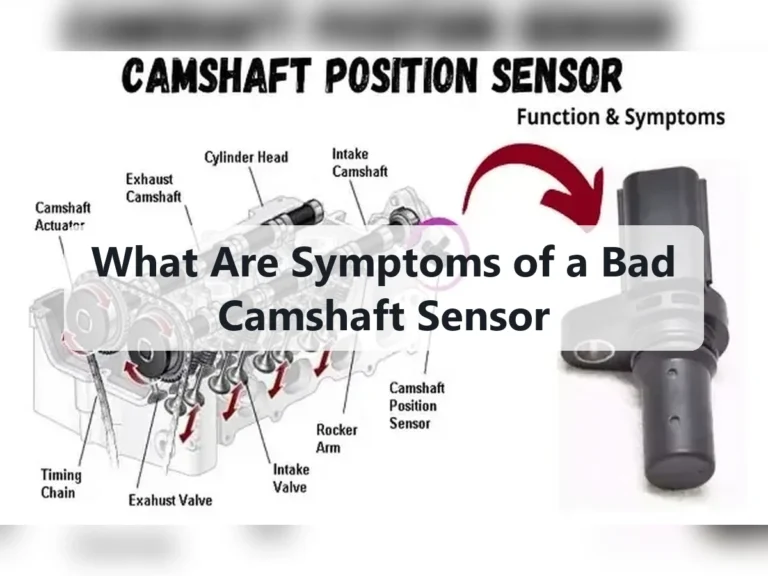
The camshaft position sensor monitors camshaft rotation and sends a position signal to the engine control module. The computer compares this information with the crankshaft position sensor signal to understand where the engine is within its combustion cycle.
This synchronization is particularly useful for sequential fuel injection, cylinder identification, ignition control on applicable engines, variable valve timing operation, and misfire monitoring. During cranking, the computer needs reliable timing information before it can manage combustion correctly.
Most modern camshaft sensors use a Hall-effect or magnetic sensing principle and read a trigger wheel, reluctor, or target connected to the camshaft. As the target passes the sensor, the electrical signal changes. The engine computer interprets that pattern rather than simply checking whether voltage is present.
This distinction explains why testing only resistance or supply voltage may not always reveal the problem. A sensor can have electrical power and ground yet still produce an unusable signal. When diagnosis becomes difficult, viewing the signal with an oscilloscope while the engine is cranking provides much more information about signal shape and cam-to-crank synchronization.
Source: hitchesguide.com
Camshaft position
Identifies the rotational position of the camshaft and helps determine which cylinder is on its compression stroke.
Crankshaft position
Provides engine speed and crankshaft angle information that is fundamental to ignition and fuel control.
Cam and crank synchronization
Allows the engine computer to coordinate cylinder-specific events accurately.
Symptoms of a Bad Camshaft Sensor That Can Accompany a No Start
A crank-no-start is more suspicious for a camshaft position problem when it appears with other cam-sensor-related symptoms. The strongest clues usually come from a combination of starting behavior, diagnostic trouble codes, live scan data, and electrical testing rather than from one symptom alone.
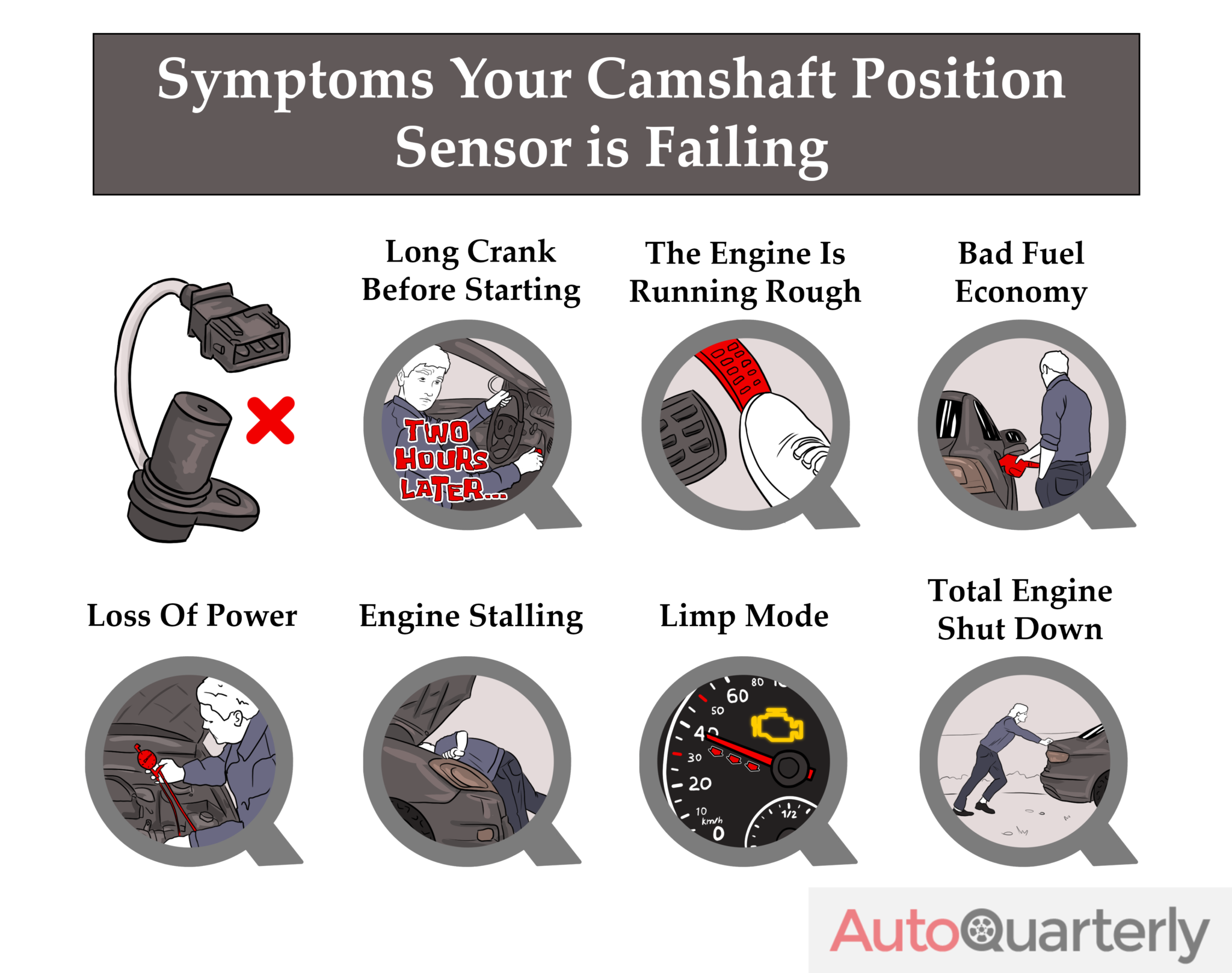
A failing sensor may first cause occasional long cranking before progressing to intermittent stalling or failure to restart. Heat-related electronic failures are also possible, so a vehicle may start normally after sitting overnight but develop trouble after the engine compartment becomes hot.
Source: youtube.com
Extended cranking
The starter turns the engine longer than normal before combustion begins.
Intermittent no start
The engine starts normally at some times but cranks without firing at others.
Unexpected stalling
Loss of the sensor signal while driving may cause the engine to stall on vehicles that cannot maintain operation without it.
Check engine light
Camshaft position or correlation trouble codes may be stored in the powertrain control module.
Rough running or misfires
An unstable position signal can interfere with accurate combustion control.
Reduced performance
The computer may enter a fallback operating strategy when a reliable camshaft signal is unavailable.
Common Camshaft Position Sensor Trouble Codes
P0340 and P0341 are among the codes commonly associated with camshaft position sensor A. Depending on the engine, additional codes in the P0340 through P0349 range or corresponding bank-specific codes may appear.
A trouble code identifies the circuit, signal, or system where the computer detected a problem. It does not automatically identify the failed component. A P0340 code, for example, may result from a defective sensor, an open or shorted circuit, connector damage, signal interference, loss of sensor power or ground, or another condition that prevents the computer from receiving the expected signal.
P0340
Generally indicates a camshaft position sensor A circuit malfunction.
P0341
Generally identifies a camshaft position sensor A circuit range or performance problem.
Correlation codes
Codes involving camshaft and crankshaft correlation can indicate electrical faults, variable valve timing problems, or incorrect mechanical timing.
How to Diagnose a No Start Before Replacing the Camshaft Sensor
Diagnose the no-start systematically instead of assuming that a camshaft code means the sensor should be replaced. A gasoline engine generally needs adequate cranking speed, compression, properly timed ignition, appropriate fuel delivery, and usable engine-position information to start. Finding which requirement is missing narrows the problem much faster.
Start with simple checks that can affect every electronic system. A weak battery can reduce cranking speed and system voltage enough to create misleading symptoms or unstable sensor signals. Confirm that the battery is adequately charged, terminals are secure, and the engine cranks at a normal speed before moving deeper into sensor diagnosis.
Source: storage.googleapis.com
Step 1: Check the battery and cranking behavior
Confirm that the battery is charged, cable connections are secure, and the starter turns the engine normally.
Step 2: Scan all stored codes
Record current, pending, and history codes before clearing anything. Look for camshaft, crankshaft, correlation, voltage, and communication faults.
Step 3: Review live data while cranking
Look for engine RPM and, when supported by the scan tool, camshaft and crankshaft synchronization status.
Step 4: Inspect the cam sensor connector and harness
Check for oil contamination, moisture, bent terminals, corrosion, damaged insulation, loose pins, or wiring rubbed against hot or moving components.
Step 5: Verify electrical supply and ground
Use the correct wiring diagram and vehicle-specific specifications to check sensor power, reference voltage where applicable, and ground integrity.
Step 6: Test the sensor signal
A scope or suitable diagnostic equipment can reveal whether the sensor produces a consistent signal while the engine is cranking.
Step 7: Check mechanical timing when needed
If electrical signals are missing or cam and crank timing does not correlate correctly, verify that the camshaft is actually rotating and that the timing belt, chain, tensioners, and trigger components are intact.
Check Engine RPM During Cranking
Engine RPM on a scan tool is a useful early clue because it can help show whether the engine computer is receiving crankshaft-speed information. If RPM remains at zero while the engine physically cranks, investigate the crankshaft position signal and related wiring before blaming the camshaft sensor.
RPM alone does not prove that every crankshaft or camshaft signal is correct. It simply helps establish a diagnostic direction. Some vehicles also provide a cam-crank synchronization parameter that can be especially helpful during a crank-no-start diagnosis.
Confirm Spark and Injector Operation
A technician may also determine whether the engine has spark and whether the fuel injectors are receiving a command during cranking. If both disappear at the same time, a missing engine-position signal becomes more significant. If position data is normal but fuel pressure is absent, the problem may instead be in the fuel delivery system.
Fuel and ignition testing involves moving engine components, high voltage, gasoline, and potentially flammable vapors. Use proper test equipment and vehicle-specific procedures. If you are not equipped to perform these tests safely, professional diagnosis is the better option.
Other Problems That Can Look Like a Bad Camshaft Sensor
Several faults can imitate a failed camshaft position sensor, which is why replacing the sensor immediately after seeing P0340 is a common diagnostic mistake. The circuit includes more than the sensor itself, and the cam signal is also influenced by mechanical components that determine when the trigger target passes the sensor.
One particularly important possibility is incorrect mechanical timing. If a timing belt breaks or a timing chain jumps far enough, the camshaft may stop rotating correctly relative to the crankshaft. The computer can then report missing or implausible camshaft information even though the sensor electronics are capable of working.
Source: engineerskill.blog
Damaged sensor wiring
Broken, shorted, melted, or chafed wiring can interrupt the signal between the sensor and engine computer.
Corroded or loose connector
Poor terminal contact can create an intermittent signal that behaves much like an internally failing sensor.
Faulty crankshaft position sensor
Loss of crankshaft position information can cause a strong crank-no-start condition and may complicate camshaft-related diagnosis.
Mechanical timing problem
A jumped chain, broken belt, worn timing components, or damaged trigger wheel can prevent proper synchronization.
Low system voltage
A weak battery or poor electrical connections can reduce cranking speed and disturb electronic signals.
Fuel or ignition failure
A bad fuel pump, insufficient fuel pressure, ignition-system failure, or related electrical fault may create the same basic crank-no-start symptom.
Engine control or shared circuit problem
Less commonly, a control-module fault or a short on a shared reference circuit can affect multiple sensors at once.
Can a Broken Timing Belt Cause a Camshaft Sensor Code?
Yes. If the camshaft does not rotate as expected because a timing belt has failed, the engine computer may see no valid camshaft position pattern or may detect that cam and crank signals no longer correlate. On some engines, a sudden no-start accompanied by unusually fast or uneven cranking can be a warning that mechanical timing or compression needs to be checked.
Do not continue repeatedly cranking an engine when a serious timing failure is suspected. Some engines can suffer internal valve and piston damage when valve timing is lost.
How to Tell a Camshaft Sensor Problem From a Crankshaft Sensor Problem
Camshaft and crankshaft position sensors work together, but their failures do not always produce identical symptoms. The crankshaft position signal is commonly fundamental to determining engine speed and crank angle, so loss of that signal is a major suspect when a vehicle suddenly stalls and then cranks without starting.
Loss of a camshaft position signal can also prevent starting, but many engines have a strategy that allows operation without it. In those vehicles, the more typical result may be extended cranking, a check engine light, reduced performance, or an intermittent starting problem.
The distinction should be confirmed with data rather than symptoms alone. Scan-tool RPM, cam and crank synchronization status, stored codes, and actual signal waveforms provide much stronger evidence than guessing which sensor is responsible.
Source: hitchesguide.com
Camshaft sensor failure
May cause long cranking, intermittent starting, rough operation, stalling, reduced performance, or complete no start depending on the vehicle.
Crankshaft sensor failure
Can prevent the computer from reliably determining engine speed and crank position and is an important cause to investigate when an engine cranks but never attempts to start.
Best distinction
Use scan data and signal testing rather than relying only on how the engine behaves.
Should You Replace the Camshaft Sensor If the Car Will Not Start?
Replace the camshaft position sensor only after diagnosis gives reasonable evidence that the sensor itself is faulty. A trouble code by itself is not enough because the engine computer monitors the entire circuit and the expected behavior of the signal.
Before buying a sensor, inspect the connector and nearby wiring, check available scan data, confirm power and ground according to the correct wiring diagram, and determine whether a usable signal is present. Also consider whether mechanical timing could explain the missing or incorrect signal.
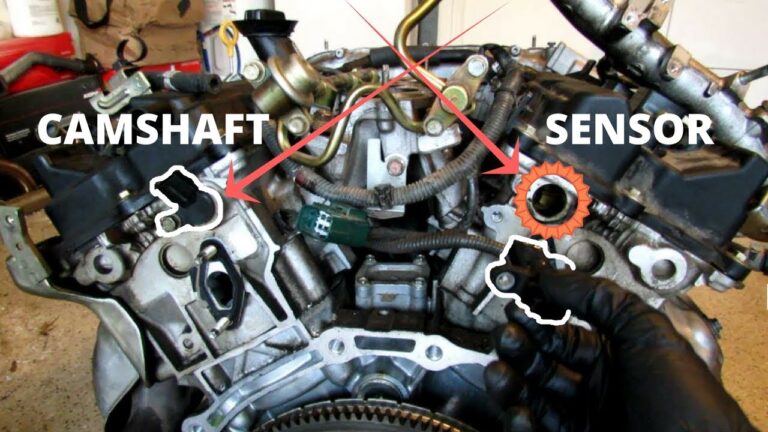
If testing confirms that the sensor has failed, replacement is often mechanically straightforward on vehicles where the sensor is easily accessible. Location varies widely, however. Some sensors are mounted near the cylinder head, timing cover, valve cover, or rear of the engine, and surrounding components may need to be removed for access.
Use the correct sensor for the exact year, make, model, engine, and sensor position. Engines with multiple banks or camshafts may use more than one camshaft position sensor, and replacing the wrong sensor will not correct the fault.
After repair, clear diagnostic codes only after recording them, start the engine, verify that the original symptoms are gone, and rescan the vehicle. Some applications may require a relearn or other manufacturer-specific procedure.
Source: hitchesguide.com
Replace it when
Testing confirms correct power and ground but the sensor does not generate the expected signal, or vehicle-specific diagnosis directly identifies the sensor as faulty.
Do not replace it yet when
Wiring damage, connector corrosion, missing reference voltage, incorrect mechanical timing, or another position-sensor fault has not been ruled out.
Seek professional diagnosis when
The no-start requires waveform analysis, mechanical timing verification, advanced electrical diagnosis, or testing that cannot be performed safely with available equipment.
What If a New Camshaft Sensor Does Not Fix the No Start?
If a correctly specified replacement sensor does not restore starting, return to diagnosis instead of installing more parts. Confirm that the new sensor receives the correct electrical supply and that its signal reaches the engine computer. Inspect the harness carefully, particularly where it passes near hot exhaust components, brackets, pulleys, or other areas where insulation can be damaged.
Next, check the crankshaft position signal, cam and crank synchronization, ignition, injector control, fuel pressure, compression, and mechanical timing as appropriate. A newly installed sensor cannot fix a broken wire, damaged trigger wheel, failed crankshaft sensor, or jumped timing chain.
FAQs About Can a Bad Camshaft Sensor Cause No Start
Q
Will an engine crank with a bad camshaft position sensor?
Usually, yes. The camshaft position sensor normally does not control whether the starter motor physically turns the engine. A failed sensor can therefore produce a condition in which the engine cranks normally but does not fire and run. If the starter does not crank the engine at all, investigate the battery, starter circuit, neutral-safety or clutch-interlock system, ignition switch, and related electrical components before focusing on the camshaft sensor.
Q
Can a bad camshaft sensor cause intermittent starting?
Yes. An internal sensor fault, loose terminal, damaged wire, or heat-sensitive electrical problem can cause the signal to disappear only under certain conditions. The vehicle may start when cold, refuse to restart when hot, and operate again after cooling. Capturing scan data or sensor waveforms while the failure is actually occurring is especially useful for intermittent faults.
Q
Does a P0340 code mean the camshaft sensor is definitely bad?
No. P0340 identifies a problem involving the camshaft position sensor circuit or expected signal. The cause may be the sensor, wiring, connector, electrical supply, control circuit, crankshaft-related issue, damaged trigger component, or mechanical timing problem. Testing the system before purchasing a sensor reduces the chance of replacing a good part.
Q
Can a car start with the camshaft position sensor unplugged?
Some vehicles can start and run with the camshaft position sensor disconnected because the engine computer can use crankshaft information and a fallback strategy. Other vehicles may crank for an extended period or may not start at all. Unplugging the sensor is therefore not a universal or conclusive diagnostic test.
Q
Can a bad crankshaft sensor be mistaken for a bad camshaft sensor?
Yes. The two signals are closely related, and a crankshaft position problem can create starting symptoms that resemble a camshaft sensor failure. Depending on the vehicle and fault, related trouble codes can also appear. Checking engine RPM during cranking, cam and crank synchronization, wiring, and actual sensor signals helps separate the two problems.
✦ Wrapping Up
Conclusion
A bad camshaft sensor can cause no start, especially when the engine computer cannot synchronize fuel and ignition events without a reliable camshaft position signal. However, the effect varies by vehicle. Some engines will not start, while others may crank longer than normal, start intermittently, stall, or continue running through a fallback strategy.
For a U.S. driver dealing with a crank-no-start condition, the most useful next step is diagnosis rather than immediately replacing the camshaft position sensor. Check the battery and cranking speed, scan for trouble codes, review RPM and synchronization data, inspect the connector and wiring, and verify power, ground, and signal operation. If those checks do not explain the problem, investigate the crankshaft position sensor, fuel and ignition systems, compression, and mechanical timing.
💡 Key Takeaway
If your engine cranks but will not start and a camshaft-related code is present, record the codes and test the camshaft sensor circuit and cam-crank synchronization before replacing the sensor. If you cannot safely perform electrical, fuel, ignition, or mechanical timing tests, have the vehicle diagnosed by a qualified repair professional.
Ethan Brooks is an automotive writer at Auto News 7, covering car news, vehicle maintenance, new model updates, recalls, and practical buying guides. He focuses on clear, useful information that helps drivers understand their vehicles and make better ownership decisions.