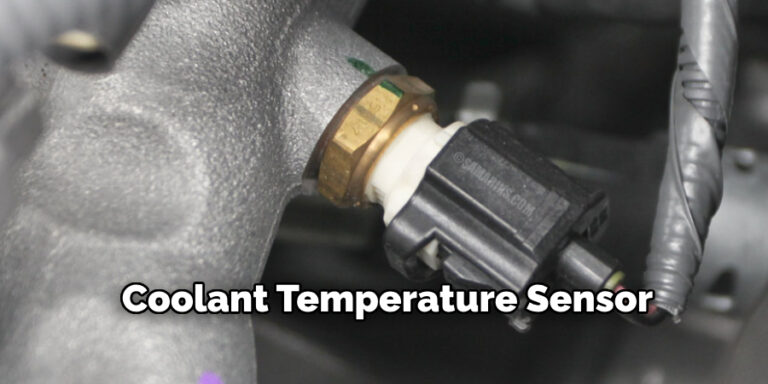
The coolant temperature sensor usually does not directly switch the radiator fan on and off. In most modern vehicles sold in the United States, the sensor sends engine temperature information to the engine control module or powertrain control module, which then decides when to command the cooling fan through a relay, fan control module, or electronic driver.
For vehicles on U.S. roads, the exact cooling-fan strategy depends on the year, make, model, engine, and control system. Many modern vehicles use an engine coolant temperature sensor, often called an ECT sensor, as a key input for fan control. The sensor measures coolant temperature and provides an electrical signal that the engine computer interprets.
The distinction matters when diagnosing an overheating vehicle. A bad coolant temperature sensor can cause incorrect fan operation, but the sensor is not necessarily the component that supplies power to the fan. The control chain may include the ECT sensor, ECM or PCM, fan relay or control module, fuse, wiring, and fan motor. Air-conditioning operation, vehicle speed, refrigerant pressure, and other inputs can also affect fan operation on some vehicles.
Source: 2carpros.com
How the Coolant Temperature Sensor and Fan Work Together
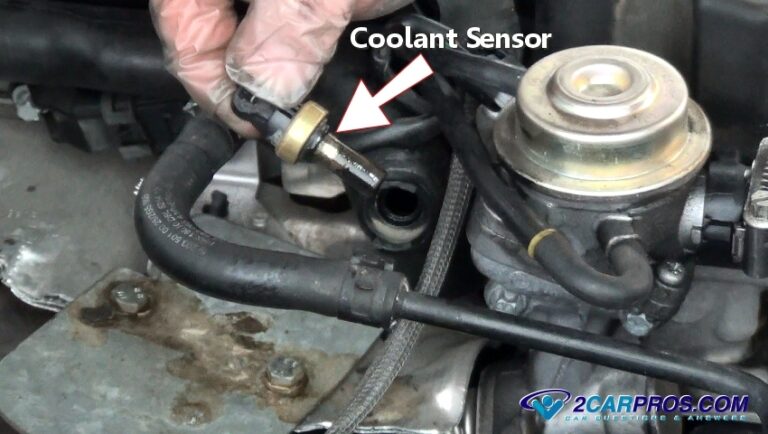
The coolant temperature sensor is an input device in the engine management system. It monitors the temperature of the engine coolant and changes its electrical characteristics as temperature changes. The ECM or PCM reads that signal and uses it to determine the engine’s thermal condition.
When the computer determines that additional airflow through the radiator is needed, it can command the cooling fan. Depending on the vehicle, the command may operate a conventional fan relay, a fan control module, or an electronically controlled fan motor. This means the sensor influences fan operation without necessarily controlling the fan directly.
Modern cooling systems may use several conditions at the same time. The control module can consider coolant temperature, vehicle speed, air-conditioning operation, refrigerant pressure, and other sensor inputs. At highway speed, natural airflow through the radiator may reduce the need for an electric fan, while a stationary vehicle may need more fan airflow.
Source: i.ebayimg.com
Coolant temperature sensor
Measures coolant temperature and sends a corresponding electrical signal to the engine computer.
ECM or PCM
Interprets sensor information and determines whether cooling-fan operation is required.
Relay or fan control module
Provides or regulates the electrical power needed to operate the cooling fan on systems that use these components.
Cooling fan motor
Turns electrical power into airflow through the radiator and condenser when commanded.
Why the sensor does not usually switch the fan directly
An ECT sensor on a modern electronically managed engine normally produces a variable signal rather than acting as a simple high-current switch. The computer can then apply programmed logic to decide when the fan should operate and, on some vehicles, which speed should be used.
Older vehicles and some specific cooling systems can use a dedicated temperature-sensitive fan switch or another direct control arrangement. Because system designs differ, the vehicle’s factory wiring diagram or service information is the best authority for determining exactly which component commands the fan.
Modern electronic systems
The ECT sensor normally provides information to an ECM or PCM, which commands the fan circuit.
Older or different designs
Some vehicles use a dedicated thermal fan switch or other control arrangement, so the ECT sensor may not be involved in fan control in the same way.
What Happens When the Coolant Temperature Sensor Fails
A failed coolant temperature sensor or damaged sensor circuit can cause the engine computer to receive an incorrect temperature signal. The resulting fan behavior depends on how the vehicle’s control strategy handles an implausible or missing signal.
In some vehicles, a sensor or circuit fault can cause the fan to run continuously as a protective strategy. In other situations, an incorrect temperature signal can prevent normal fan activation. The same symptom can also result from a failed relay, fan module, motor, fuse, wiring problem, or computer-side fault.
Because these symptoms overlap, replacing the coolant temperature sensor solely because the fan does not work is not a reliable diagnostic method. The sensor signal and the complete fan circuit should be tested before replacing parts.
Source: i.ytimg.com
Fan runs constantly
A failed sensor or circuit can cause some control systems to default to continuous fan operation as a protective response.
Fan does not turn on
A bad temperature signal can prevent the control module from receiving a valid reason to command the fan, although other electrical or mechanical faults can cause the same symptom.
Check engine light
An ECT sensor or circuit fault may set a diagnostic trouble code, but the exact code and test procedure depend on the vehicle.
Poor engine operation
Because coolant temperature is also used for fuel, ignition, idle, emissions, and other engine-management decisions, an inaccurate temperature signal can affect more than fan operation.
Why a bad sensor can make the fan run all the time
Some control systems use a fail-safe strategy when the engine computer detects an implausible coolant-temperature signal. Running the fan can provide additional cooling protection when the computer cannot confidently determine the actual engine temperature. This behavior is vehicle-specific and should not be treated as a universal rule.
Open or implausible sensor circuit
The ECM or PCM may recognize that the temperature signal is outside its expected range and enter a protective operating strategy.
What Else Controls the Radiator Fan
The coolant temperature sensor is only one part of many cooling-fan systems. The engine computer can use multiple inputs and electrical components to determine whether the fan should operate. This is why a non-working fan should be diagnosed as a system rather than by replacing the temperature sensor first.
Air-conditioning operation is particularly relevant. On many vehicles, the cooling fan also helps move air across the A/C condenser, so the fan may operate even when engine coolant temperature alone would not require it. Some systems also use refrigerant pressure or vehicle speed as inputs.
Source: i.ytimg.com
Air-conditioning system
The fan may be commanded when the A/C system requires airflow through the condenser.
Vehicle speed
Higher road speeds naturally provide more airflow through the radiator, so fan control can change with vehicle speed.
Fan fuse
A blown fuse can interrupt power to the fan circuit and prevent operation even when the control command is correct.
Fan relay
A defective relay can prevent battery power from reaching the fan motor on systems that use relays.
Fan control module
Electronically controlled systems may use a dedicated module or integrated electronics to regulate fan speed.
Fan motor
A worn or failed motor can stop the fan even when the computer and control circuit are functioning correctly.
Wiring and connectors
Corrosion, loose terminals, damaged wiring, or poor grounds can interrupt the sensor or fan circuits.
Why the fan may run when the engine is not overheating
Fan operation does not necessarily mean the engine is overheating. The computer may command the fan for A/C condenser cooling, after-run cooling, or another programmed condition. Some vehicles can also continue operating the fan for a period after the ignition is switched off. Always keep hands and tools away from the fan because it can start unexpectedly.
A/C operation
The fan can run to manage condenser temperature or refrigerant pressure.
Post-shutdown operation
Some vehicles intentionally keep the cooling fan running after the engine is switched off.
How to Diagnose a Cooling Fan Problem
Start with the vehicle’s service information because fan activation logic and test values vary by application. A scan tool can be especially useful because it may show the coolant temperature reported to the ECM or PCM and allow controlled testing of the fan on supported vehicles.
Do not assume that the fan should switch on at one universal temperature. Manufacturers use different activation points, fan speeds, hysteresis ranges, A/C strategies, and fail-safe responses. The correct temperature and test procedure must come from the vehicle-specific service information.
Source: i.ytimg.com
1. Check for overheating
If the temperature gauge indicates overheating, steam is present, coolant is boiling, or a warning appears, stop safely and shut the engine down as appropriate. Do not open a hot pressurized cooling system.
2. Check diagnostic trouble codes
Use a compatible scan tool to check for engine coolant temperature sensor, fan control, and related powertrain codes.
3. Check live coolant temperature data
With the engine cold, compare the scan-tool coolant-temperature reading with the actual ambient conditions. A clearly implausible reading can point toward a sensor or circuit problem, but exact diagnostic limits are vehicle-specific.
4. Inspect the fan circuit
Check the relevant fuse, relay, connectors, wiring, grounds, and fan assembly according to the factory test procedure.
5. Test the fan command
If the vehicle supports bi-directional testing, a scan tool may be able to command the cooling fan. This can help separate control-side problems from fan-side problems.
6. Verify the sensor circuit
If the temperature reading is incorrect, test the sensor, reference or supply circuit, signal circuit, and ground as specified by the manufacturer.
A practical diagnostic decision path
If the scan tool shows an implausible coolant temperature, investigate the ECT sensor and its wiring first. If the reported temperature appears reasonable but the fan does not respond to a valid command, move toward the fan fuse, relay or control module, wiring, power supply, ground, and motor. If the fan operates when commanded but does not activate during normal conditions, investigate the inputs and control logic rather than immediately replacing the fan.
Incorrect temperature data
Prioritize the ECT sensor and its circuit.
Correct temperature but no fan response
Check the fan command path, fuse, relay or module, wiring, power, ground, and motor.
Fan works under a commanded test
Investigate the conditions and inputs that normally trigger fan operation.
Common Mistakes When Diagnosing the Coolant Temperature Sensor
The most common mistake is treating every fan problem as a coolant temperature sensor problem. The sensor can influence fan control, but a fan circuit contains several other possible failure points. A proper diagnosis checks the signal and the actuator circuit rather than relying on one symptom.
Another mistake is using a generic fan activation temperature as a universal test. Fan thresholds vary significantly between vehicles and can change according to A/C operation, vehicle speed, engine configuration, and other conditions.
Source: mechlesson.com
Replacing the sensor without testing it
A non-working fan does not by itself prove that the ECT sensor is defective.
Ignoring the A/C system
A fan may operate because of A/C-related control logic even when coolant temperature is normal.
Assuming the fan must run at idle
The fan may remain off under some normal conditions, particularly when coolant temperature and other control inputs do not require additional airflow.
Opening a hot cooling system
Removing a radiator or expansion-tank cap while the system is hot can release pressurized coolant and cause severe burns.
Working near an energized fan
Electric cooling fans can start automatically, including after the engine has been switched off. Keep hands, clothing, and tools clear.
Can a Bad Coolant Temperature Sensor Cause Overheating
Yes, a faulty coolant temperature sensor can contribute to overheating on vehicles where the sensor provides an important input for cooling-fan control. If the control system receives an incorrect signal and does not command the fan when cooling is required, coolant temperature can rise, especially during low-speed or stationary operation.
However, the sensor is only one possible cause. A failed fan motor, blown fuse, defective relay, damaged wiring, faulty fan module, low coolant level, thermostat problem, water-pump problem, radiator restriction, or other cooling-system fault can also cause overheating.
The safest approach is to diagnose the complete cooling system rather than assuming the ECT sensor is responsible. If the engine is actively overheating, continued driving can turn a relatively simple cooling-system problem into major engine damage.
Source: s2.studylib.net
Sensor-related overheating
Possible when incorrect temperature information prevents the control system from responding correctly.
Fan-related overheating
A failed motor, fuse, relay, module, wiring connection, or ground can prevent required airflow.
Mechanical cooling-system problems
Low coolant, poor coolant circulation, thermostat faults, radiator restrictions, and water-pump problems can also cause excessive temperature.
Does the Coolant Temperature Sensor Control Fan Speed
It can influence fan speed, but the exact method depends on the vehicle. Some systems provide only an on-and-off fan command or use separate low- and high-speed relay circuits. Other vehicles use a fan control module or electronically controlled motor that can provide multiple speeds or continuously variable operation.
In these systems, coolant temperature is one of the inputs used by the ECM or PCM. The computer can combine temperature information with vehicle speed, A/C conditions, and other inputs before selecting the appropriate fan state.
Source: 2carpros.com
Single-speed systems
The control system may simply switch the fan on or off when specified conditions are met.
Two-speed systems
Relays or other circuitry can provide separate low- and high-speed operation.
Variable-speed systems
A control module or electronic fan assembly can adjust fan speed according to the computer’s command.
Why fan operation differs from vehicle to vehicle
There is no single fan-control design used across every vehicle in the United States. A compact car, pickup truck, hybrid, luxury vehicle, and older passenger car can use substantially different cooling strategies. The same basic relationship remains useful for understanding modern systems: the temperature sensor provides information, the control system makes the decision, and the fan circuit carries out the command.
Vehicle-specific calibration
Fan activation points and speeds are programmed according to the engine and cooling-system design.
Multiple inputs
Coolant temperature may be combined with A/C, vehicle-speed, pressure, and other signals.
When to Stop Driving and Get Professional Help
A cooling-fan problem can become an overheating problem quickly under the right conditions. If the temperature warning light comes on, the gauge enters the overheating range, coolant is visibly boiling, steam is escaping, or the engine shows signs of severe overheating, stop driving when it is safe to do so and allow the system to cool.
Professional diagnosis is especially appropriate when the fan circuit involves electronic modules, complex wiring, or manufacturer-specific diagnostic procedures. A qualified technician can use a scan tool, wiring diagrams, electrical test equipment, and vehicle-specific service information to determine whether the fault is in the sensor, control system, or fan assembly.
Source: i.ytimg.com
Stop for active overheating
Do not continue driving an engine that is overheating simply because the vehicle still runs.
Do not open a hot cooling system
Wait until the system has cooled sufficiently before inspecting or servicing coolant components.
Treat the fan as an automatic moving part
Never place hands or tools near the fan without following the manufacturer’s service precautions.
Frequently Asked Questions
Q
Does the coolant temperature sensor turn the radiator fan on?
Usually, it does not turn the fan on directly. The coolant temperature sensor sends temperature information to the ECM or PCM, and the control module typically commands the fan through a relay, fan control module, or electronic driver. Some older or specialized systems can use a direct temperature-sensitive fan switch.
Q
Can a bad coolant temperature sensor make the fan stay on?
Yes. On some vehicles, an open, shorted, or implausible coolant temperature signal can cause the control system to run the fan continuously as a protective strategy. The exact fail-safe behavior varies by vehicle.
Q
Can a bad coolant temperature sensor stop the fan from working?
It can on systems that rely on the ECT signal for fan control. However, a failed fuse, relay, fan motor, control module, connector, wiring circuit, or ground can produce the same symptom. Testing is necessary before replacing the sensor.
Q
Should the radiator fan turn on when the engine is cold?
Not necessarily. Many vehicles keep the engine cooling fan off during cold operation unless another condition, such as A/C operation or a specific control strategy, requires it. Some vehicles may run the fan under conditions that have nothing to do with high coolant temperature.
Q
How can I tell whether the coolant temperature sensor or fan is bad?
A scan tool can help by showing the coolant temperature reported to the engine computer and, on supported vehicles, allowing a controlled fan command. If the temperature data is implausible, inspect the sensor and its circuit. If the temperature data is reasonable but the fan does not respond to a valid command, investigate the fan’s fuse, relay or control module, wiring, power supply, ground, and motor.
✦ Wrapping Up
Conclusion
The coolant temperature sensor usually does not directly control the radiator fan. Instead, it supplies temperature information to the ECM or PCM, which uses that information with other inputs to determine whether the cooling fan should operate and, on some vehicles, what speed it should use.
That distinction is important when diagnosing a fan problem. A defective ECT sensor can cause abnormal fan behavior, but the fault may also be in the fan motor, fuse, relay, control module, wiring, or another cooling-system component. Because fan-control strategies differ by vehicle, the manufacturer’s service information should determine the correct test conditions and specifications.
💡 Key Takeaway
If your radiator fan is not operating correctly, do not replace the coolant temperature sensor based on the symptom alone. Check diagnostic trouble codes and coolant-temperature data, then test the fan control circuit and fan assembly according to the vehicle-specific service procedure. If the engine is overheating, stop driving and address the cooling-system fault before further operation.
Ethan Brooks is an automotive writer at Auto News 7, covering car news, vehicle maintenance, new model updates, recalls, and practical buying guides. He focuses on clear, useful information that helps drivers understand their vehicles and make better ownership decisions.
Learn how the engine coolant temperature sensor can affect car AC operation, compressor control, cooling fans, symptoms of failure, and practical diagnostic steps.
Learn how to check an engine coolant temperature sensor with a multimeter or OBD-II scanner. Follow safe testing steps, resistance checks, symptoms, and troubleshooting tips.
Learn how to test camshaft position sensor wiring with a multimeter. Follow a safe step-by-step process to check power, ground, signal circuits, and common wiring faults.
Learn what a knock sensor detection system is, how it detects engine knock, how the ECU responds, common symptoms, testing methods, and repair considerations.